
HATSUNE MIKU: COLORFUL STAGE!
SEGA CORPORATIONMusic
4.510.31K Reviews
- Version
- 6.1.0
- Installs
- 10.00M
- Age Rating
- Everyone
Screenshots




Our Review of HATSUNE MIKU: COLORFUL STAGE!
 Analysis by Appyee
I judge a rhythm game by more than whether its songs make me want to tap along. I also want to know whether I can read the playfield quickly, find my way around without hunting through menus, and enjoy a session in the situations where I actually use my phone. HATSUNE MIKU: COLORFUL STAGE! makes a lively first impression, but its speed and visual energy mean it suits some players and settings better than others.
Finding your way through the music
I find the quickest way to judge a rhythm game is to separate learning its menus from learning its timing. Here, the cast and story give browsing a purpose between songs, while the playfield asks for focused attention once a track starts; deciding which side you want more of can help you tell whether its layered presentation will feel inviting or busy.
Readable screens, lively presentation
The colorful look is part of the appeal: Hatsune Miku and the other performers give the game a clear identity, and the animated presentation makes it feel like more than a bare lane of notes. I find that visual personality inviting, especially if I already enjoy vocal-synth music or virtual-idol stories. The trade-off is that a rhythm screen asks me to focus on timing, so the surrounding motion and color can compete for attention when I am still learning a song.
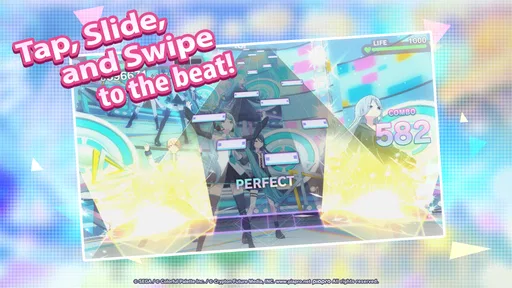
The basic actions are easy to understand: tap, slide, and hold notes in time. That low barrier helps a new player get started without learning a complicated control scheme first. It does not mean every chart will feel easy, though. Reading a pattern while listening and reacting quickly takes practice, and a song that feels comfortable at one point can become demanding when its note flow gets busier. I recommend beginning with tracks and difficulties that let you watch the lanes calmly rather than chasing a high score straight away.
Menus and story content give the game more to do between performances, but they also make it a fuller experience than a simple pick-a-song-and-play rhythm app. If you want only an instant musical challenge, extra character and band material may feel like a detour. I see that as a useful choice rather than a flaw: players who enjoy getting to know the cast have another reason to return, while players focused on timing can keep their attention on the performance itself.
Touch, timing, and sensory comfort
Because the controls rely on touch, the game is a natural fit for someone comfortable making quick, repeated gestures on a phone screen. Sliding and holding add variety to tapping, but they also make hand position matter. I get a steadier feel when I hold the device in a way that leaves my thumbs free to move and avoid playing while walking or carrying something. If prolonged tapping is uncomfortable for you, short sessions are a sensible way to test the feel before committing to longer runs.
The music is central, so headphones can make it easier to follow a track in a noisy room; at home, the phone speaker may be enough for a casual session. Volume and surroundings matter more than the game’s colorful presentation suggests: a busy visual scene plus loud music can become tiring, while a quiet, focused setting makes it easier to separate the beat from the animation. I would lower the volume and take a break if the combination stops feeling enjoyable. The game’s appeal depends on sound and fast visual cues, so it is not the best choice when either is hard for you to use comfortably.
A practical tip is to treat each attempt as a small test rather than a verdict on your ability. If a sequence keeps tripping you up, pause between runs, listen for the musical phrasing, and watch where the notes enter the play area. That gives you a chance to anticipate rather than simply react. It is more useful than repeatedly playing at full intensity when your hands are tired or your attention has drifted.
Where it fits into an ordinary day
I can see myself opening it during a quiet break, choosing a song, and playing one or two runs before getting back to the day. That works best when I have a stable seat and enough attention to follow the rhythm. It is less suitable for a crowded commute if I need to watch where I am going, or for a moment when I cannot hear the track clearly. Rhythm games reward concentration; trying to squeeze one in while distracted can turn a relaxing pause into a string of missed notes.
Compared with a stripped-down rhythm game that puts almost everything into the song challenge, this one has a broader mix of performers, character stories, and customization. That extra context can make it more welcoming if I want to spend time with the fictional bands, not just improve a score. On the other hand, someone who wants a minimal interface and an immediately accessible playlist may prefer a simpler alternative in the genre. The right choice depends on whether the surrounding world feels like a bonus or an interruption.
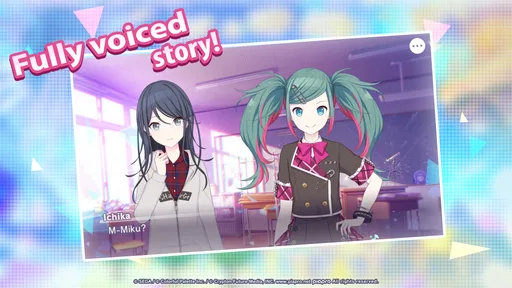
The story is another reason to play at a different pace. The characters and bands have their own arcs, so I do not need to treat every visit as a high-score session. I can spend one session following the narrative and another concentrating on the music. That split is especially useful for someone who likes rhythm games but does not always have the energy for rapid input; the story gives the app a quieter mode of engagement, even though the performances remain its central attraction.
What to expect before committing
There is a substantial song selection, with familiar material alongside newer tracks, and more content opens as you progress. That creates a gradual reason to keep playing, but it also means the experience is not necessarily an all-access song library from the first moment. I would approach it as a game to explore over time rather than assume every song or option will be ready immediately. If choosing from a large range is your main priority, take a moment to see how the available choices feel before deciding whether the progression suits you.
Cost is worth considering, too. The game is free to download, while optional in-app purchases range from $0.49 to $79.99 per item. That is a wide span, so I would set a personal spending limit before browsing any optional purchases, especially if collecting outfits or other extras is likely to tempt you. You can enjoy the basic idea without treating every customization choice as necessary; the best value comes from the music and play experience you genuinely want, not from feeling pressured to complete a collection.
For context, the game is published by SEGA CORPORATION and sits in the music-game category. It was released on December 6, 2021, and version 5.0.5 is listed for devices running Android 8.0 or later. Its Everyone age rating gives families a helpful starting point, though I would still consider whether fast screen movement, headphone use, and optional purchases suit the particular player. It is free to start, but the purchase range makes a conversation about spending worthwhile for younger players.
The audience response suggests it has reached well beyond a small niche: it has a 4.5 average from around 149,000 ratings and over 10 million installs. That popularity does not guarantee it will fit your hands, hearing, attention, or taste, but it does mean a new player is stepping into an established community around Miku and the game’s other performers. I would use that as context, not as a substitute for trying the controls and presentation yourself.
A personal rhythm-game recommendation
My strongest recommendation is for players who want both musical timing challenges and a cast they can follow. Fans of Hatsune Miku have an obvious reason to look, but newcomers can also enjoy the straightforward tap, slide, and hold foundation. The stories and customization give longer-term players something to care about outside a single score, while unlocking more content supplies a gentle sense of discovery.
I would hesitate to recommend it to someone seeking a quiet, low-stimulation game, a purely minimal rhythm interface, or a music experience that does not depend on rapid touch input. It is also not my first choice when I am tired, distracted, or somewhere I cannot comfortably hear and watch the action. Those are situational limits, not reasons to dismiss the game; they simply matter when deciding when and how to play.
On balance, I find the mix of music, animated performers, and character stories more distinctive than a basic score-chasing alternative. The same richness can make the experience busier, and the touch-driven timing asks for focus, so it is worth trying with modest expectations rather than assuming every session will be effortless. For a player who enjoys learning songs and returning to a cast over time, that balance is appealing.
Hey there! So, let me dive right into my latest obsession: HATSUNE MIKU: COLORFUL STAGE!. If you’re into rhythm games and adore virtual idols, you’re in for a treat. I’ve been tapping away on my screen for hours, and honestly, I’m hooked.
From the moment you launch the app, you’re greeted with vibrant colors and a mesmerizing soundtrack that sets the stage for what's to come. The aesthetics are downright beautiful, with a slick interface that’s easy on the eyes. I mean, who doesn’t love a game that’s visually stunning and has a killer soundtrack?
The game features our beloved digital diva, Hatsune Miku, along with a cast of other virtual performers. If you’re a fan, seeing Miku and her friends come to life in such detail is something special. You can tell right away that a lot of love and effort went into crafting this game.
Gameplay Mechanics
Alright, let’s talk about how the game actually plays. The mechanics are pretty straightforward, which is a good thing if you’re like me and sometimes get overwhelmed by overly complicated controls. You’ll be tapping, sliding, and holding notes in time with the music. It’s that classic rhythm game formula, but with a twist that keeps it fresh.
One thing I found super engaging is the variety of songs available. The setlist is extensive and features a mix of classic hits and new tracks. It’s like a musical treasure trove! Plus, as you progress, you unlock more content, which keeps the game feeling fresh and exciting.
Story and Characters
Now, let's chat about the story. Yes, there’s more to this game than just tapping to the beat. The narrative is surprisingly deep, with different bands and characters each having their own story arcs. I didn’t expect to get so invested, but here I am, rooting for my favorite virtual bands.
The character development is impressive. Each member has a distinct personality and backstory, making them more relatable and engaging. You’ll find yourself wanting to learn more about their journeys and dreams, which adds a whole new layer to the gameplay.
Customization and Features
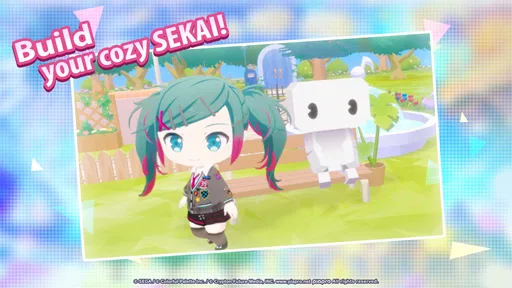
Customization is where Hatsune Miku really shines. You can deck out your favorite characters in a variety of costumes and accessories. It’s like playing dress-up, but with way cooler outfits. This feature adds a personal touch that makes the game feel uniquely yours.
Another fun aspect is the social feature, where you can connect with other players. Sharing your scores, achievements, and even collaborating on challenges adds a competitive edge that keeps you coming back for more.
Graphics and Sound
The graphics are top-notch. Seriously, the character models and animations are smooth and lifelike. It’s a visual feast that complements the high-energy vibe of the game. And the sound? Well, it’s a rhythm game, so you bet the music is on point. The audio quality is crisp, and the tracks are catchy as heck.
Whether you’re using headphones or playing through your phone's speakers, the sound experience is immersive. It’s hard not to get lost in the music as you play.
Final Thoughts
All in all, HATSUNE MIKU: COLORFUL STAGE! is a must-try for rhythm game enthusiasts and Miku fans alike. It’s got the perfect mix of engaging gameplay, stunning visuals, and an incredible soundtrack. I’ve been having a blast playing, and I’m sure you will too.
If you’re ready to tap, slide, and groove your way to victory, this game is definitely worth downloading. So, what are you waiting for? Dive into the colorful world of HATSUNE MIKU: COLORFUL STAGE! and let the music take over!
Privacy and Permissions
See what permissions an app requests and how it handles your data.
- Photos/Media/Files
- read the contents of your USB storage, modify or delete the contents of your USB storage
- Storage
- read the contents of your USB storage, modify or delete the contents of your USB storage
- Wi-Fi connection information
- view Wi-Fi connections
- Other
- view network connections, pair with Bluetooth devices, full network access, control Near Field Communication, control vibration, prevent device from sleeping, Google Play license check
Verdict
Strengths of HATSUNE MIKU: COLORFUL STAGE!
- Engaging rhythm gameplay with dynamic visuals.
- Diverse song library featuring popular artists.
- Customizable characters enhance user experience.
- Regular updates keep content fresh and exciting.
- Strong community support and active fan base.
Limitations of HATSUNE MIKU: COLORFUL STAGE!
- Requires stable internet connection to play.
- In-app purchases can be pricey for some users.
- Some features locked behind progression walls.
- Game may lag on older devices occasionally.
- Limited offline functionality reduces accessibility.
Other Releases by SEGA CORPORATION
View All
Sonic Rumble Party
Action4.3

P5X | Persona5: The Phantom X
Role Playing4.3

FIST OF THE NORTH STAR
Action4.6
Similar Picks in This Category
View All
Tiles Hop Music & Ball Game
AMANOTES PTE. LTD.4.3

Magic Tiles 3™ - Piano Game
AMANOTES PTE. LTD.4.6

Real Piano
Bilkon3.7

Piano Game: Classic Music Song
Dream Tiles Piano Game Studio4.0

Smash Colors: Music Ball Rush
BADSNOWBALL HONGKONG LIMITED4.2

Piano Music Go-EDM Piano Games
Joy Journey Music Games4.5
Frequently Asked Questions
What is the main objective of HATSUNE MIKU: COLORFUL STAGE!?
HATSUNE MIKU: COLORFUL STAGE! is a rhythm game where players tap along to the beat of their favorite Vocaloid songs. The objective is to complete levels by hitting notes in time with the music, achieving high scores, and unlocking new content such as songs, characters, and customization options.
Is HATSUNE MIKU: COLORFUL STAGE! free to play?
Yes, the game is free to download and play on both Android and iOS devices. However, it includes in-app purchases for various items like premium currency, character outfits, and additional songs. These purchases are optional, and players can enjoy the core gameplay without spending money.
What devices are compatible with HATSUNE MIKU: COLORFUL STAGE!?
HATSUNE MIKU: COLORFUL STAGE! is available on both Android and iOS platforms. For Android, it requires a device running Android 6.0 or later. For iOS, it is compatible with iPhones and iPads running iOS 10.0 or later. Ensure your device meets these requirements for optimal performance.
Can I play HATSUNE MIKU: COLORFUL STAGE! offline?
No, HATSUNE MIKU: COLORFUL STAGE! requires an internet connection to play. The game frequently updates with new content and events, and playing online ensures access to these features. A stable connection is necessary for downloading additional songs, participating in events, and synchronizing game data.
Are there social features in HATSUNE MIKU: COLORFUL STAGE!?
Yes, the game includes social features that allow you to connect with friends. You can join teams, compete in events, and share your achievements. The game also incorporates leaderboards, so you can see how your scores compare to other players globally, adding a competitive edge to the experience.
Play our best games!


